
AQuRA
  • Home
  • News
  • About
    • ERIAB members
  • Tasks
  • Deliverables
  • Partners
    • University of Amsterdam
    • Menlo Systems
    • LTE, CNRS
    • Exail
    • Nicolaus Copernicus University
    • NKT Photonics
    • QuiX Quantum
    • PTB
    • Vexlum
    • Vrije Universiteit Amsterdam
  • Open Positions
    • Amsterdam
    • Nicolaus Copernicus University, Torun
  • Media
    • in the media
    • for the media
  • Contact
  • Symposium
    • Speakers

AQuRA

​Bringing the best clocks in the world to society

Welcome to AQuRA!

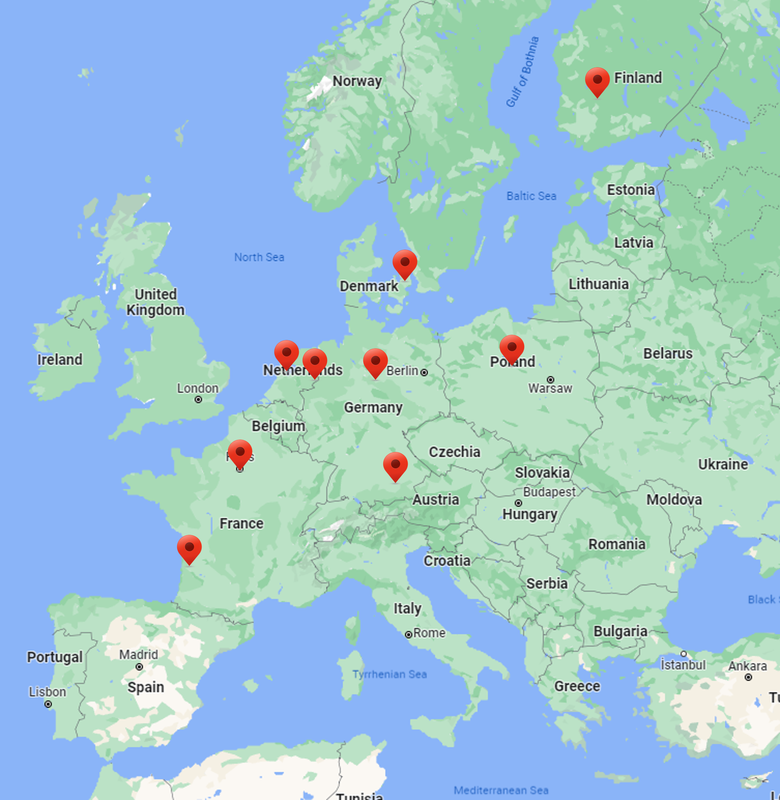
AQuRA, the Advanced Quantum Clock for Real World Applications, is a European consortium of five industry leaders,  two national measurement institutes and three universities. The AQuRA clock will be the first industry led clock prototype aiming for instability and uncertainty at around a second over the age of the universe. 

Such precise and accurate clocks are crucial for the precise navigation, communications and sensing challenges that underpin our modern society.
Picture
The goal of AQuRA is to make the best clocks in the world robust and compact enough for real world applications. These "optical atomic clocks" are amazingly accurate. If such a clock would have been turned on during the Big Bang, almost fourteen billion years ago, the clock would still be ahead or behind by around a second today!

AQuRA aims to make existing optical clocks smaller and more robust. Currently, these clocks do not look like the clocks in your home – they are complicated machines that fill entire laboratories. AQuRA wants to make these clocks transportable, so that they can be used for measurements in the field and eventually even sent to space using satellites. This could for example make GPS systems much more accurate.

AQuRA is one of the quantum technology related projects that together form the European Commission's Quantum Flagship initiative.

On this website, you will find our latest news, an overview of the project's tasks, a more detailed description of the twelve partner institutes that make the project possible and open positions. as well as an overview of media appearances and materials. If you want to know more about AQuRA, don't hesitate to contact us!

More about the AQuRA project...

Recent news

Picture
Picture
30 July 2025: System integration and installation at Menlo Systems. The construction of the AQuRA clock has entered a crucial phase: system integration at Menlo Systems. AQuRA partners are visiting Menlo Systems to integrate and install their system components. Several lasers have been successfully locked, the physics package is being refined and the light distribution module is being implemented. Stay tuned for more updates from Munich!
Picture
29 June 2025: AQuRA/CoCoRICO Symposium brings together optical atomic clock community in Innsbruck
Navigation, data communication and telecommunication - many areas of our modern, digital and information driven society critically depend on the availability of highly precise and stable clocks. In recent years, tremendous progress has been made  in the development of optical clocks: the best clocks to date reach a stability of 10^(-18) or beyond. While these high-stability clocks are operated at research institutes or national metrology institutes (NMIs), the first commercial optical clocks are currently entering the market as an alternative to, for example, hydrogen masers.

Despite their enormous potential, further advancements on both the clock system level, the underlying technology supply chain and their metrological qualification are required before optical clocks will be ready for broad deployment - and overcoming these challenges will require international collaboration.
To stimulate such collaboration, the AQuRA and CoCoRICO (https://cocorico.obspm.fr/) projects hosted a symposium on “Optical Clocks and Enabling Technology” on June 29 in Innsbruck, Austria. This provided a lively platform for the exchange of ideas, the discussion of challenges and the initiation of new connections and collaborations. 

More info? Download the press release.
Picture
10 July 2025: QuRIOUS: a new doctoral programme on optical quantum clocks
The European Commission has decided to fund the doctoral network QuRIOUS – Quantum Research and Innovation in Optical clocks for Upcoming Scientists – which will train and develop the skills of 15 doctoral students on the topic of optical clocks and their applications. The programme will be coordinated by the University of Amsterdam, and involves eleven academic and industrial partners throughout Europe, as well as eleven additional associated partners. Read the news item from the University of Amsterdam here.
More news items...
Picture
This project has received funding from the European Union’s Horizon Europe research and innovation programme
​​under grant agreement No 101080166
 (AQuRA project).
  • Home
  • News
  • About
    • ERIAB members
  • Tasks
  • Deliverables
  • Partners
    • University of Amsterdam
    • Menlo Systems
    • LTE, CNRS
    • Exail
    • Nicolaus Copernicus University
    • NKT Photonics
    • QuiX Quantum
    • PTB
    • Vexlum
    • Vrije Universiteit Amsterdam
  • Open Positions
    • Amsterdam
    • Nicolaus Copernicus University, Torun
  • Media
    • in the media
    • for the media
  • Contact
  • Symposium
    • Speakers